
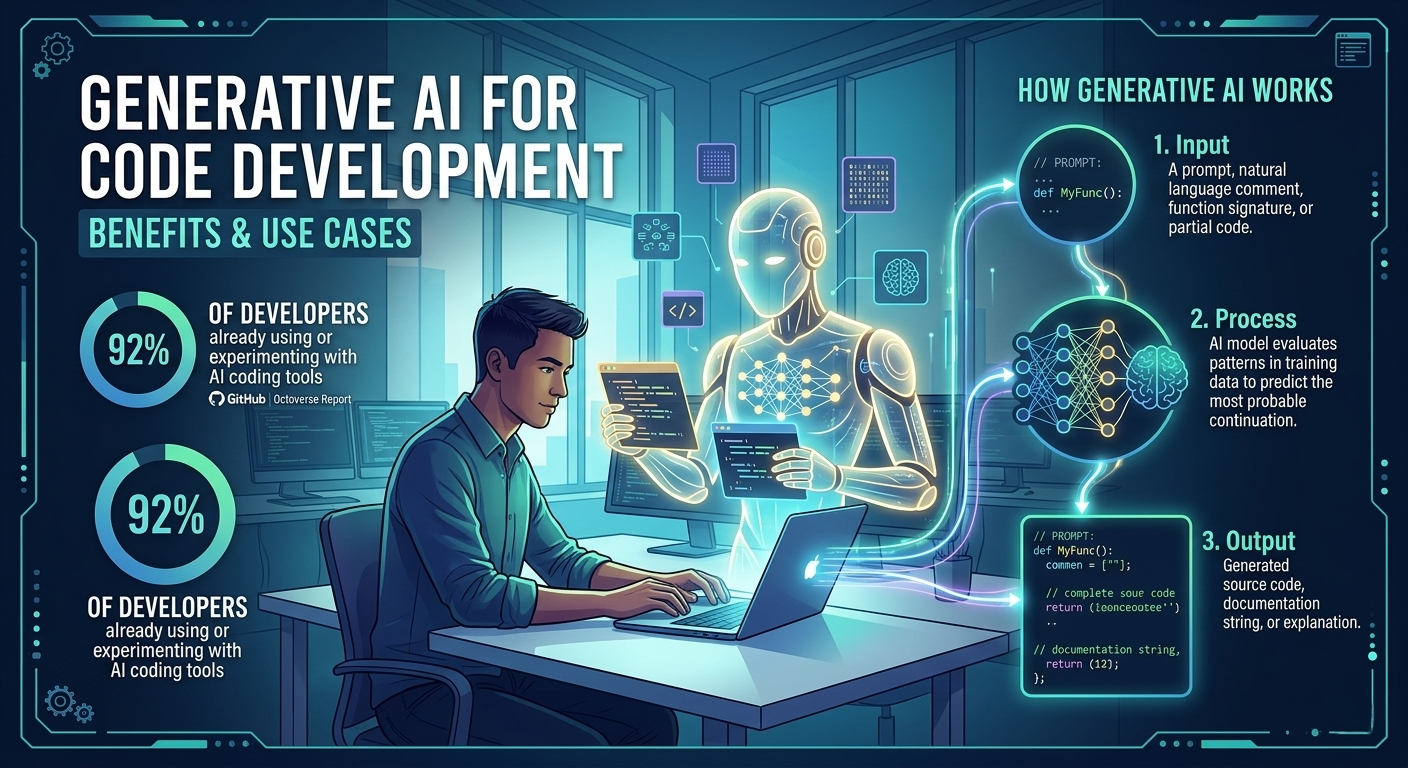
Software teams at companies of every size now treat AI-assisted development as standard practice. According to GitHub’s Octoverse report, 92% of developers are already using or experimenting with AI coding tools. For engineering managers and technical decision-makers, the practical question is no longer whether to adopt generative AI for code development, but which tasks it genuinely accelerates and where the risk still sits. This guide covers the core mechanics, the real business benefits, the limitations, and how enterprise teams can implement AI coding tools with confidence.
What Is Generative AI?
Generative AI is a class of machine learning that produces new content, including text, images, or code, based on patterns learned from large training datasets. Given a prompt or partial input, the model generates a plausible, contextually appropriate completion. Understanding how that process works is useful context before examining where it applies in software work.
How Generative AI Works
A generative model takes a sequence of tokens as input and predicts the most probable next output. For code, the basic processing loop follows three steps:
- A prompt is submitted, either as a natural language comment, a function signature, or a partial code block
- The model evaluates the input against patterns in its training data and predicts the most probable continuation
- Output is returned as source code, a documentation string, or an explanation, depending on what was requested
Large Language Models Behind AI Coding Tools
Most AI coding assistants are powered by large language models (LLMs) trained on billions of lines of public and proprietary code. Models such as GPT-4o, Claude, and Codex recognise patterns across dozens of programming languages, which gives them the ability to generate, explain, and debug code across different technical stacks.
Difference Between Traditional Automation and Generative AI
Traditional code automation, such as build scripts or template generators, follows fixed rules and produces predictable outputs. Generative AI coding interprets intent from natural language and generates novel code, adapting to context in ways rule-based systems cannot.
What Is Generative AI for Code Development?
Generative AI for code development refers to using AI models to assist or automate software engineering tasks, from writing new functions and generating test coverage to reviewing existing logic and producing technical documentation. The defining characteristic is that the model generates output based on described intent, not a predefined template.
AI-Assisted Software Engineering
AI-assisted software engineering keeps engineers in the decision-making role while AI handles mechanical production work. Engineers review, refine, and approve what the model suggests. The result is a faster delivery workflow without removing the accountability that production-grade software requires.
How AI Generates Source Code
The generation workflow is straightforward, but each step matters for output quality:
- A developer writes a comment or natural language prompt describing what the function should do
- The model reads the surrounding code context alongside the prompt
- It generates a complete or partial function that matches the described behaviour and the existing code style
- The engineer reviews, adjusts, and approves before the code enters a pull request
Common Development Tasks AI Can Support
Generative AI coding currently adds measurable value across:
- Writing boilerplate code and repetitive functions
- Generating unit tests from existing logic
- Explaining unfamiliar or undocumented codebases
- Producing inline comments and API documentation
- Suggesting fixes for flagged errors or failing tests
Key Benefits of Generative AI for Software Development
The productivity case for AI software development is well documented across teams of different sizes and stacks. These are the five areas where engineering organisations consistently report measurable gains.
Faster Development Cycles
Teams using AI code generation report measurable reductions in time spent on first drafts, particularly for well-defined tasks such as CRUD operations, API wrappers, and data transformation logic. Companies at full AI adoption report a 113% increase in pull requests per engineer.
Improved Developer Productivity
A Harvard Business School study found AI users completed tasks 25% faster with over 40% higher quality scores. For engineering teams, this means senior engineers spend less time on boilerplate and more time on architecture, code review, and design decisions.
Reduced Repetitive Work
AI programming tools handle the parts of software work that follow consistent patterns, such as writing similar functions across modules or adapting existing logic to a new data structure. This reduces cognitive load on engineers without changing their technical ownership of the output.
Better Documentation Generation
Documentation is frequently skipped under delivery pressure. AI coding assistants generate inline comments, README files, and API documentation directly from source code, keeping documentation synchronised with the codebase without requiring dedicated time from the team.
Faster Debugging and Refactoring
AI models identify likely causes of failing tests, suggest cleaner implementations of working code, and flag potential edge cases. This compresses the debugging cycle without removing the engineer’s final judgement on the fix.
Common Use Cases of Generative AI in Coding
Generative AI development applies across the full software delivery cycle. The use cases below reflect where enterprise teams are seeing repeatable, measurable returns today.
Code Generation
AI code generation handles the first draft of new functions, modules, or entire files from a prompt. Output quality scales with how precisely the prompt describes expected inputs, outputs, and constraints.
Code Completion
Tools such as GitHub Copilot autocomplete code as a developer types, predicting the next line or block based on context. This is the most widely deployed form of AI-assisted coding in production teams today.
Bug Detection
AI models scan code for common error patterns, security anti-patterns, and logic inconsistencies. Combined with static analysis tools, this adds an automated review layer before code reaches human reviewers.
Test Case Generation
Given a function, the model produces a test suite covering expected inputs, edge cases, and failure conditions. This is one of the highest-ROI applications of AI generated code, saving significant time on a task that engineering teams routinely deprioritise under sprint pressure.
Documentation Creation
Beyond inline comments, AI for software engineering produces structured technical documentation, onboarding guides, and changelog summaries generated from git history or PR descriptions.
Legacy Code Modernisation
AI tools annotate legacy systems, suggest equivalent implementations in modern frameworks, and flag high-risk sections for human review. For organisations managing ageing codebases, this reduces the maintenance cost of systems that predate current architectural standards.
Generative AI Tools for Developers
AI programming tools now span three deployment models, from individual developer assistants to organisation-wide platforms. The right fit depends on team size, security requirements, and how deeply the tooling needs to integrate with existing pipelines.
AI Coding Assistants
GitHub Copilot, Cursor, and similar tools integrate directly into developer environments, suggesting completions and generating functions in response to natural language comments in real time. These are the most accessible entry point for teams beginning generative AI development.
AI Pair Programming
Some teams use AI as a continuous pair programmer: a model that reviews code as it is written, asks clarifying questions about intent, and proposes alternatives when it detects potential issues. This works well for onboarding junior developers or accelerating code review on large pull requests.
Enterprise AI Development Platforms
Enterprise platforms extend beyond individual IDE plugins to cover CI/CD pipelines, security scanning, and compliance reporting. These are appropriate for teams that need centralised control over model access, data handling, and audit logging across a large engineering organisation.
Challenges and Limitations of AI Code Generation
AI generated code is productive but not self-governing. Each of the following limitations demands an active organisational response, with policies and governance in place before teams scale usage.
Security Concerns
AI generated code can introduce vulnerabilities when reviewed carelessly, particularly in authentication flows, input validation, and dependency management. Security review must remain a required step regardless of how the code was produced.
Code Quality Validation
Models produce plausible-looking output that may not behave correctly under edge conditions. Data from 2025 shows AI-generated pull requests averaged 1.7x more issues than human-written ones, underscoring the need for thorough review before merging.
Hallucinations and Incorrect Outputs
Models occasionally generate confident, syntactically valid code that references non-existent APIs or solves the wrong problem. The output needs to be tested, not trusted on sight.
Data Privacy and Compliance
Prompts sent to external model APIs may expose proprietary logic or data structures depending on the provider’s data retention policies. Enterprise teams should establish clear policies on which models are used, how prompts are constructed, and where output goes before it reaches production.
How Businesses Can Implement Generative AI in Development Teams
Implementation approach varies significantly based on data sensitivity, team size, and how specialised the engineering workflows are. Three models cover most enterprise scenarios in AI software development.
Internal AI Coding Assistants
Companies with strict data requirements often deploy self-hosted models or air-gapped tools that keep proprietary code off external servers. This trades some model capability for full control over data flows and compliance posture.
Custom AI Development Solutions
Off-the-shelf tools cover common use cases, but teams with specialised workflows often need purpose-built solutions. A custom AI development approach allows the model to be fine-tuned on an organisation’s own codebase, style guides, and architectural conventions, producing far more relevant output than a generic assistant.
AI Agents for Software Engineering Workflows
AI agents go beyond single-turn code generation. A typical agent-driven CI workflow handles:
- Running the test suite after each proposed code change
- Reading test output and identifying which assertions failed
- Generating targeted fixes and re-running tests to confirm the result
- Flagging the reviewed output for engineer sign-off before merging
Integrating agents into CI/CD pipelines is an active area of enterprise AI solutions development for large engineering organisations looking to automate routine delivery work end-to-end.
Future of Generative AI for Code Development
The trajectory for AI for software engineering is moving from task-level assistance towards workflow-level autonomy. These three directions are already visible in how leading engineering organisations are structuring their AI investments.
Human-AI Collaboration
The near-term direction is closer collaboration between engineers and models: engineers define intent and constraints, AI handles implementation, and code review becomes the central engineering function for the team.
Autonomous Development Workflows
End-to-end feature development from a ticket description is already in testing at larger organisations. The reliability bottleneck is automated test coverage, not model capability. As testing frameworks mature, the scope of autonomous workflows will expand.
Enterprise Adoption Trends
Enterprise AI spending on development tools hit $37 billion in 2025, up from $11.5 billion in 2024. By 2026, over 80% of enterprises are projected to use generative AI APIs or deploy AI-enabled applications. Teams that treat AI coding as part of a broader business process automation strategy are compounding productivity gains quarter over quarter.
Conclusion
Generative AI for code development is a productivity layer, not a replacement for engineering judgement. It compresses time spent on implementation, documentation, and testing, giving teams more capacity for design, architecture, and review. The organisations seeing the most consistent returns are those that integrate AI coding tools with clear governance, proper review processes, and solutions built for their specific technical environment.


